
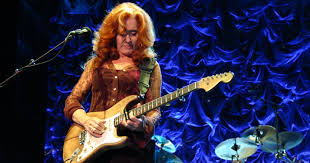


The blues has long been defined by the guitar. While male players like B.B. King and Stevie Ray Vaughan often dominate popular narratives, female guitarists have shaped the genre with equal fire and originality. They brought their own voices, combining technical mastery with emotional storytelling. This list highlights ten of the greatest female blues guitarists of all time, musicians who not only played the instrument but expanded its possibilities.
Sister Rosetta Tharpe
Often called the “Godmother of Rock and Roll,” Sister Rosetta Tharpe fused gospel with blues and electrified audiences from the 1930s onward. Playing her Gibson Les Paul Custom and other hollow-body electrics, she bent strings and drove rhythm sections with a power rarely seen in her era. Her innovative lead guitar work anticipated rock and directly influenced players from Chuck Berry to Eric Clapton. Tharpe’s contribution was not just her pioneering technique but the way she put guitar at the center of her performance, blazing a trail for women in a field almost entirely dominated by men.
Memphis Minnie
Born Lizzie Douglas in 1897, Memphis Minnie was one of the most prolific blues musicians of the early 20th century. She recorded over 200 songs and proved herself both a gifted songwriter and a sharp guitarist. Her fingerpicking style combined ragtime rhythms with blues phrasing, giving her a distinctive sound that stood out on both acoustic and electric instruments. Unlike many female singers of her era who relied on male accompanists, Minnie often outplayed her contemporaries in head-to-head musical contests. Her legacy demonstrates that technical virtuosity was never limited by gender.
Bonnie Raitt
Bonnie Raitt is widely recognized for her soulful slide guitar. Emerging in the 1970s, she fused blues, rock, and folk into a signature style that earned her both critical acclaim and commercial success. Her bottleneck slide technique is lyrical and expressive, drawing out vocal-like tones that complement her singing. Raitt’s career longevity, Grammy awards, and influence on younger artists secure her place as one of the most important blues guitarists, not just among women but overall.
Susan Tedeschi
Susan Tedeschi has built her career on blending raw blues guitar with gospel-infused vocals. Her Telecaster and Stratocaster tones are clean and cutting, marked by restraint and feel rather than excess. With the Tedeschi Trucks Band, she balances her playing alongside Derek Trucks, creating a dialogue of slide and rhythm that recalls the Allman Brothers while pushing new ground. Tedeschi’s recognition as both a frontwoman and guitarist proves her enduring influence in contemporary blues.
Ana Popović
From Belgrade to global stages, Ana Popović has redefined the modern image of a blues guitarist. Known for her fast, fiery playing and commanding stage presence, she combines Chicago blues with funk and jazz elements. Popović’s technical precision on Fender Stratocasters has earned her comparisons to top male shredders, but her phrasing remains firmly rooted in the blues. She represents the international reach of the genre and how women continue to evolve its sound.
Joanna Connor
Chicago-based Joanna Connor has been a powerhouse on the blues scene since the 1980s. Famous for her slide guitar work, often played with blistering speed and fiery improvisation, she built her reputation through live performances in packed clubs. Videos of her stage solos have gone viral, showcasing her command of both technique and raw emotion. Connor’s ability to mix tradition with modern intensity makes her a vital figure in contemporary blues guitar.
Debbie Davies
Debbie Davies earned her reputation touring with Albert Collins and later leading her own bands. She plays with a deep, Texas-blues bite, marked by crisp rhythm and stinging lead work. Her career has spanned decades, proving her dedication to keeping blues guitar alive in its most authentic forms. Davies has won multiple Blues Music Awards, and her consistency has made her a role model for female players breaking into professional circuits.
Erja Lyytinen
Hailing from Finland, Erja Lyytinen is known as the “Queen of Slide Guitar.” She brings Nordic precision to Delta traditions, creating a style that blends old and new. Lyytinen’s use of slide is melodic and soaring, and she often experiments with modern arrangements while staying true to blues roots. Her international tours and recordings have helped bring female blues guitarists to broader global audiences.
Beverly “Guitar” Watkins
Beverly Watkins was one of the hardest working guitarists to ever hit the stage. Known for her high-energy performances, she toured for decades, often pulling off stunts like playing guitar behind her head. Despite limited mainstream recognition, Watkins earned respect from peers and fans for her gritty tone and dedication to the blues. She embodied the spirit of live performance, showing how showmanship and skill could come together in unforgettable ways.
Rory Block
Rory Block is a master interpreter of traditional country blues. Her acoustic fingerpicking honors legends like Robert Johnson and Mississippi John Hurt, yet she brings her own intensity and precision to every performance. Block has dedicated her career to keeping acoustic blues alive, teaching, recording, and touring with unwavering commitment. She proves that technical mastery and historical preservation can exist alongside personal artistry.
The Impact of These Guitarists
These ten women demonstrate that blues guitar is not defined by gender but by skill, innovation, and dedication. From the raw gospel of Sister Rosetta Tharpe to the contemporary fire of Ana Popović and Joanna Connor, each guitarist has contributed something unique to the genre. They have expanded the role of the guitar in blues music, influenced generations of musicians, and broken barriers for women in a male-dominated industry.
The history of the blues cannot be told without these guitarists. Their playing shaped sounds that became the foundation of rock, soul, and modern electric blues. By mastering both technical skill and emotional storytelling, they elevated the instrument into a voice of resilience, joy, and defiance.
The blues thrives on authenticity. Each of these women brought their own truth to their instrument, making the guitar sing in ways only they could. That is why they stand among the greatest blues guitarists of all time.


